|
|
|
Jon Crowcroft |
|
Hermann De Meer |
|
Ken Carlberg |
|
|
|
|
|
IP architecture built on Layered Model |
|
Some current efforts bend/break the model |
|
Congestion avoidance: RED |
|
Division of resources: CBQ, WFQ |
|
QoS: diff-serv, int-serv |
|
|
|
|
|
|
|
|
|
|
Add functionality/services “on the fly” |
|
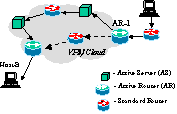
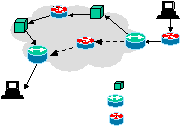
Initially, Active Router (AR) |
|
‘Reprogram’ code in data packets |
|
Active Server (AS) |
|
Dynamically loaded software modules |
|
Used as
proxies for additional services offered by the network |
|
Transcoding |
|
Dynamic VPNs |
|
|
|
|
|
|
Security |
|
Need to prevent adverse functions |
|
Approaches include strict semantics (SecuNet),
polices (Android/FAIN), and ‘sandboxes’ (execution environments) |
|
Performance |
|
‘Slow path’ for option-filled data packets in
routers |
|
Lack of inter-layer information leads to… |
|
Redundant functions between layers (e.g.,
Application layer routing/discovery) |
|
Sub-optimal performance of end-to-end flows |
|
|
|
|
|
Retain the layered model |
|
Break it for ‘active’ flows |
|
Focus solution on integrated operation between
AR and AS |
|
|
|
|
|
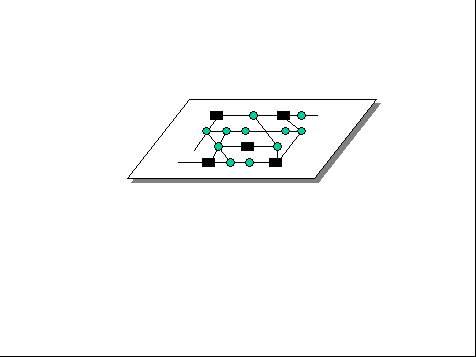
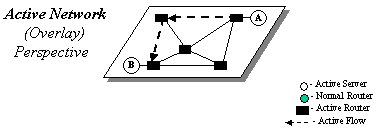
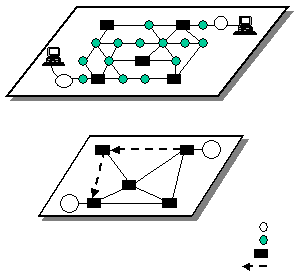
Network consisting of AR and AS |
|
Similar to ALAN architecture |
|
AS and AR communicate/compliment each other |
|
Language between AR and AS |
|
Articulate type, form, target |
|
Expansion of Secunet language(?) and/or
XML-programable router project(??) |
|
Policies |
|
|
|
|
|
|
|
|
|
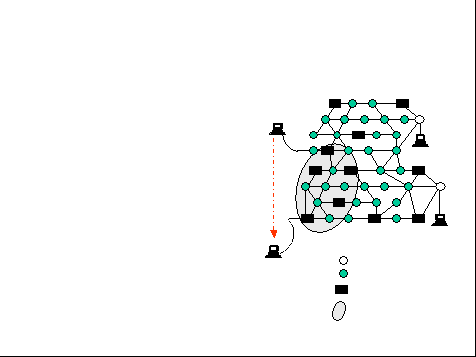
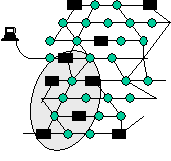
Active Flow through AS-A and AS-B |
|
AS-A determines that flow is subject ‘active’
service |
|
AS-A triggers AR to send constrained flood |
|
Determine new paths with different metrics |
|
Constrain advertisement to shaded region using
‘active’ routing protocol |
|
|
|
Note: Example represents |
|
gradual active service |
|
|
|
|
NATs and Firewalls |
|
Nat’s operate like a primative network AN device |
|
Firewalls act like an application layer
(possibly) |
|
Need to coordinate (e.g. the tweaking/open door
protocol) between the two |
|
|
|
|
Reflection is a neat tool for distributed
systems middleware |
|
C.f. work at lancaster and irvine on reflection
for mobile and multimedia |
|
Seems ideal for Bi-Level architecture too! |
|
|
|
|
Good reasons for 2 levels of overlay |
|
Can achieve 3 or more just by recursing, so no
need for n-layer model, unlike ISO |
|
Need to work on the meta-object protocol in the
real sense of the word protocol so that two layers can comprehend each
others internal behaviours. |
|

 Notes
Notes