Welcome to the homepage of Hubert Fonteijn.
I am a research associate at the department of Computer Science at UCL, London.
I am working on measuring structural and functional connectivity using MRI. Below you can find brief descriptions of the projects I have been involved in and current work
You can also download my cv HERE
Convection Enhanced Delivery of Drugs
In my post-doc project I am collaborating with neurosurgeons and mathematicians in Bristol. Our aim is to develop patient-specific models of drug distributions after applying Convection Enhanced Delivery (CED) of drugs.
It is difficult to administer drugs to the brain, because of the Blood-Brain Barrier. In CED, drugs are directly infused into either the grey or white matter of the brain. To be able to do this, we need to be able to predict how the distribution of drugs in the brain will develop over time. My colleagues in Bristol are developing sophisticated models of drug transport. My part in this project is to use Diffusion Imaging to provide them with patient-specific information about local microstructure such as local direction of the microstructure and volume fraction.
Probabilistic Q-Ball Imaging
Diffusion MRI, and especially Diffusion Tensor Imaging are established tools to determine the fibre direction of white matter. However, DTI suffers from the fact that it cannot resolve more than one fibre direction per voxel. Q-Ball Imaging is an alternative that is mode-free and can characterize multiple fibre directions per voxel. In this project, we have investigated a statistical extension of this technique to characterize the uncertainty of the fibre directions. We have done this by applying Markov Chain Monte Carlo sampling techniques on a Spherical Harmonics representation of the Q-Ball Orientation Distribution Function. We have moreover applied model-selection procedures to determine the correct spherical harmonics order. We show that this works well in simulations and on High Angular Resolution Data.
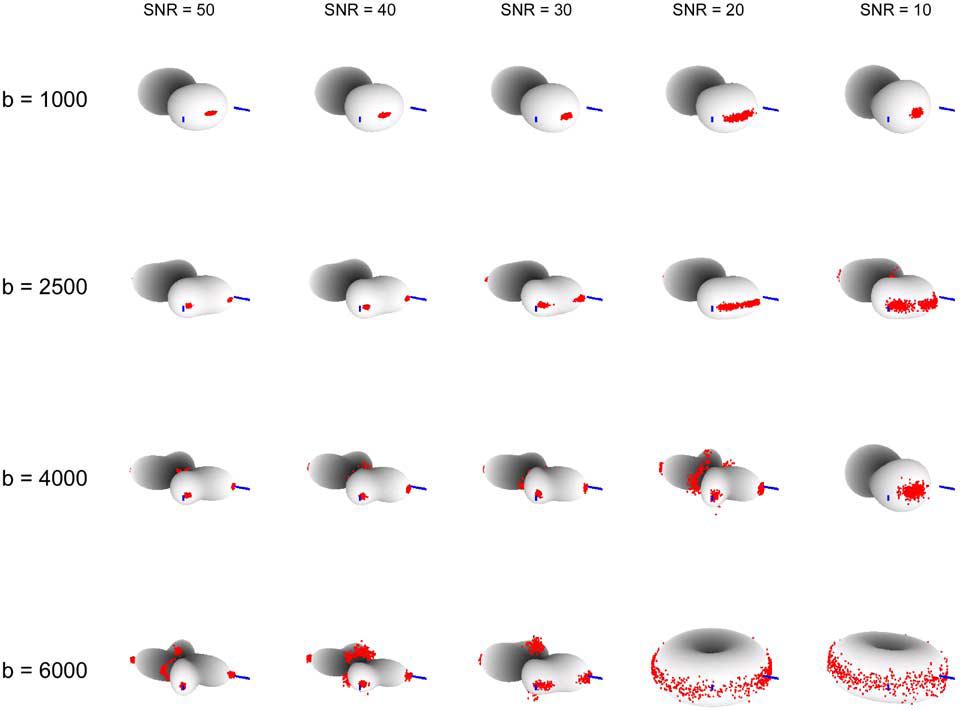
Simulations on Probablistic Q-Ball Imaging for two fibres
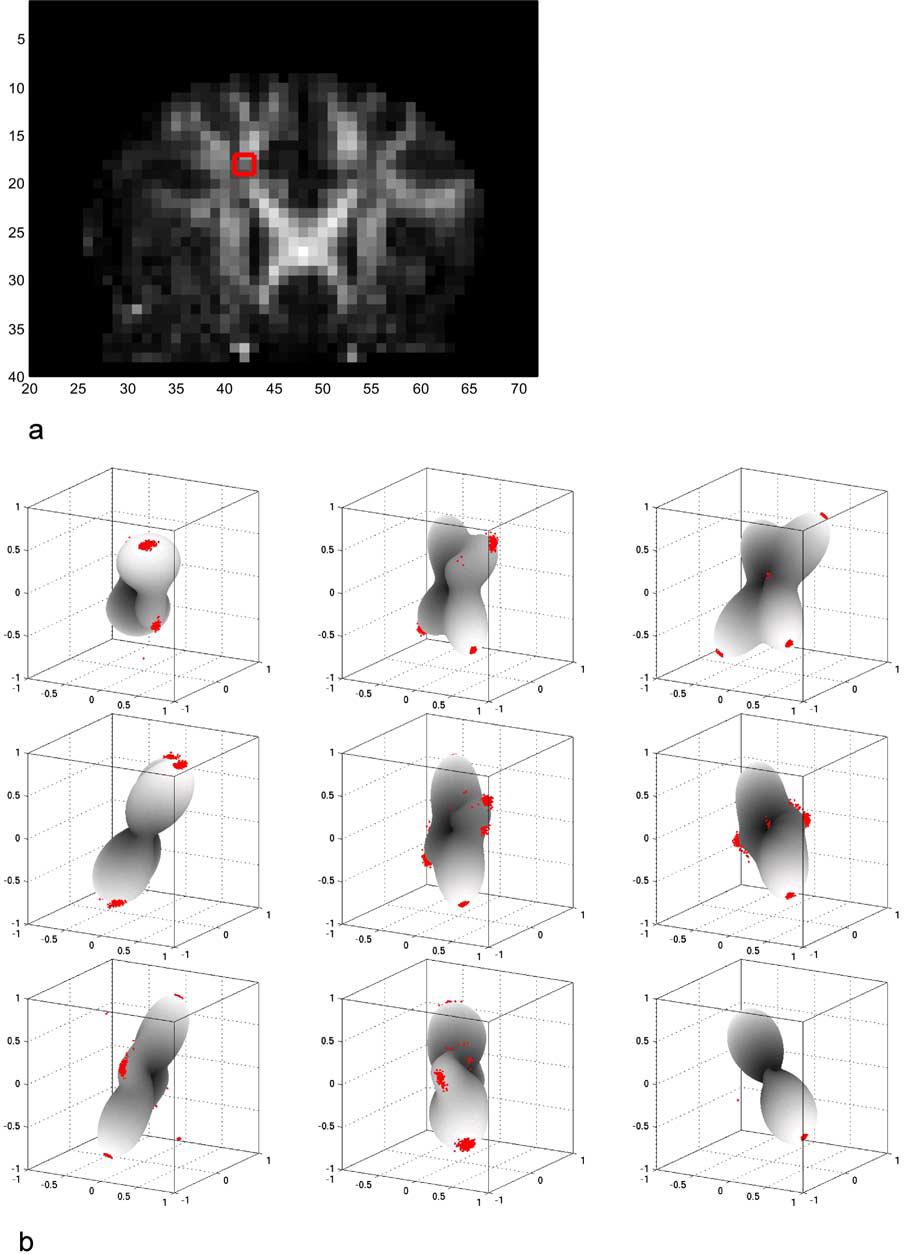
Results on HARDI-data using probablistic Q-Ball Imaging
Using tractography to support effective connectivity models
Tractography has in the last 10 years become a popular tool to study white matter connections between cortical regions. Effective connectivity models present a model-based approach to study the direct influence of one region to another when performing a task. One of the prerequisites of these models is a correct characterization of the anatomical connections between regions. In this project we have examined to what extent DTI-based fibre tractography can provide this information. We have done this using 8 effective connectivity models from published studies and using their region coordinates as seed regions for a tractography study in 6 separate studies. We have shown extensive overlap between the models proposed in the literature and our tractography results. In cases where we have not found the proposed connections we could ascribe this to well-known issues with DTI-based tractography. We have also established some cases in which DTI-based tractography shows connectivity that was not taken into account in the original effective connectivity models.
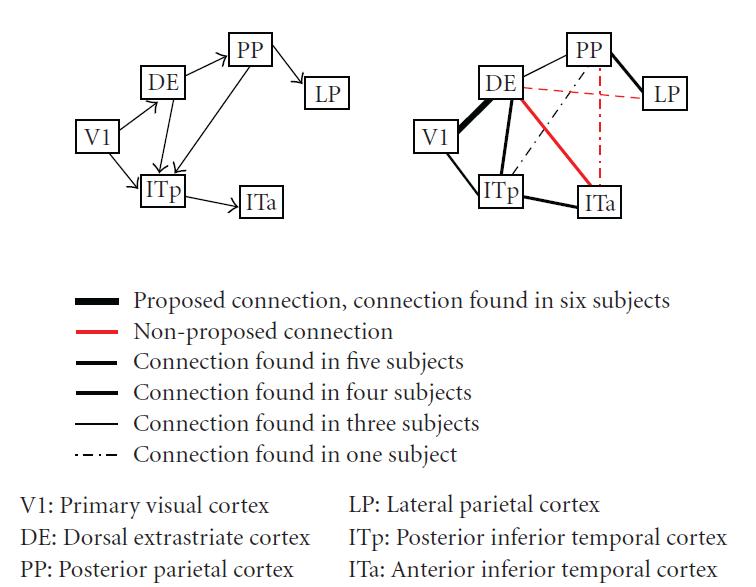
Comparison between proposed effective connectivity model (right) and results from fibre tractography (left)
h.fonteijn(at)cs.ucl.ac.uk